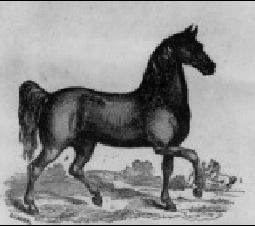
Clifton 457 – Civil War Hero
In 1855 a three-year-old bright chestnut colt caught the eye of many that were attending the New Hampshire State Fair. He won the class for three-year-old stallions. He was also “… said to be able to outstrip any animal of his age in speed.” He was reported to have made 2.40 in a time trial at Amherst the same season. That colt was Clifton 457.
Clifton was a son of the celebrated and popular parade horse Hale’s Green Mountain Morgan 42. His dam was a chestnut mare by Gifford Morgan 30 out of a mare sired by Sherman Morgan 5. He matured at 14.2 hands and weighed 960 pounds. William Bellows of Walpole, NH was his owner at birth.
At three months of age, Clifton was sold to Silas Hale of South Royalston, MA, who owned his sire. Hale later sold him to Samuel Edgerly, Manchester, NH, when eighteen months old. He was resold soon after to F.H. Lyford who owned him until at least 1857. Clifton was described as a “bold-looking, active and muscular horse” and it was stated that in many respects he resembled his “celebrated sire.”
At the New Hampshire State Fair in 1857 he won the class for Stallions, 4-7 years of age. The same year at Manchester, NH, he was matched in a five-mile walking race with Young Morrill (Perkins’) 59. Clifton won the race in one hour, two minutes, and 46 seconds. It was then the only walking match race on record. Allen Thomson wrote of the race that “Clifton … won [the] walking race … by a long distance.” Clifton’s owner at the time wrote the following lines about the race:
“When Clifton arrived on the track;
And waved his flaming tail,
Mongrels and Morrills lagged behind,
And in the distance trail.”
Clifton does not appear in the records of the New Hampshire State Fair after that time. Sometime after the match race, but prior to the Civil War, he was sold to William Capehart of North Carolina. Capehart was attending medical school in Virginia at the start of the Civil War. He went directly from medical school into the Civil War as a surgeon. According to family tradition, he was attached to Wade Hampton’s cavalry, which was a part of the Army of Northern Virginia (CSA). In a report (10 July 1862) of the 60th Regiment of the Virginia Infantry, Capehart was commended, along with surgeon H.R. Noel, for “their unwearied and skillful attentions to the wounded of the regiment.”
Clifton is one of the few Morgan horses that served in the Civil War who has been documented by name. Although Capehart is reported to have been over six feet tall, he rode Clifton through most of the War. Clifton was killed during a cavalry skirmish near Cheraw, South Carolina in March 1864.
Capehart was released from the army after the war with two horses. He returned to his 2,000-acre home plantation ‘Avoca’ near Edenton, in northeastern North Carolina, adjacent to Albemarle Sound. In time, Capehart became the owner of what became the largest seine fishery in the world. He also maintained a stable of harness racing horses complete with a track on his property. Among these horses was the registered Morgan Tornado 1656 (Fearnaught x Darkness), a black stallion foaled in 1871. Capehart acquired him about 1878.
Appreciation is extended to Ina Ish for her assistance with researching the information on W.R. Capehart compiled here. ©2004 Elizabeth A. Curler
