Happy Friday!! Here is your First Friday Flashback, carefully researched and prepared by our own Betsy Curler:
Charley Watson (or Black Morgan 2nd) 813
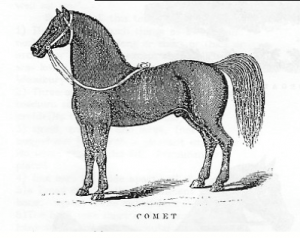
Charley Watson, a 15.2 hand black stallion, was a popular sire in Vermont’s Northeast Kingdom for a number of years. He was bred by Charles Watson, who resided just south of West Burke, Vermont. His sire was Black Morgan 810, the scion of the Black Morgan family. His dam was Watson’s Comet mare (x Wood’s Comet 682 by Billy Root 9), a prolific producer of roadsters. Watson kept for himself two of her sons, as stallions, and a daughter.
When black Morgan 810 died in 1869, George Ide replaced him with Charley Watson. Also known as Black Morgan 2nd, he was heavily patronized as a sire and his offspring became well known and highly sought after. E.H. Hoffman noted that “He was a horse of lofty carriage, with quite a long and well developed neck. He had a bold and showy way of going, with quite a little speed.”
Charley Watson’s full brother, known as Thayer’s Morgan Tiger, was similar in appearance and there was some controversy as to which one was the better horse. Dr. A.W. Hinman thought Charley Watson was the best sire in Vermont and he was quoted as saying: “Charlie Watson is the greatest sire of them all. Too bad he had to leave Vermont.” Charles Howland felt that Tiger was the much better individual. E.H. Hoffman believed that H.S. Wardner and A.F. Phillips would feel the same way if they saw both of them.
But, Hoffman himself disagreed with Howland, feeling that Charley Watson was a cleaner and classier individual than Morgan Tiger. Charley Watson was taller with a longer neck making him “a very handsome horse.” Charles Watson was considered to be an expert judge of horses. He kept Morgan Tiger, the full brother of Charley Watson, as he felt he had the better conformation of the two horses. Yet Charley Watson was the more popular breeding horse.
In 1877, George Ide sold Charley Watson to Allen Anderson of Fairview, Illinois. Anderson, a self-admitted fanatic on the matter of Morgan horses, saw his first Morgan about 1850. He was “so taken with his shape and style that I never forgot him.” He maintained the dream of wanting Morgan stallion from Vermont “of the true Morgan style” for many years.
Anderson traveled to New York and Vermont seeking his dream horse, but was much disappointed by what he saw. In Port Henry [New York], he saw “small-eyed, narrow-chested” horses; nothing that fit his “model a bit.” Even after traveling to Barton, Vermont, he did not find what he was looking for. As he was about to give up his search, someone suggested that he might find what he was looking for in Lyndon [Vermont]. There he found Black Morgan 2nd (a.k.a. Charley Watson), an old type Morgan. Anderson kept him till he died on 6 April 1889, still sound.
As there was not another Morgan stallion like him where he lived, Anderson bred him to his own daughters. After his death, he bred sisters and brothers to each other. By 1896, he was down to the fifth generation of such breeding and claimed that “they are still Morgans of the true type, with plenty of size, bone and muscle to take their masters load of hogs or grain over any roads the draft breeds can go.” He did not breed for speed as he felt that doing so would inhibit their ability as draft animals. He wanted his mares to carry at least two close crosses directly to Justin Morgan, the same as the sire was expected to possess. Anderson wanted to “cultivate the American horse for Americans.”
Anderson’s neighbor, James Ten Eyck, raised Morgans for over thirty years. He acquired Morgans of General Gifford stock in 1857. He liked them as they were “good drivers and good sellers.” He noted that Anderson had “a fine lot of black Morgans, and good ones.” Ten Eyck crossed his General Gifford stock on Black Morgan 2nd and, in his view, achieved having inbred Morgans, but “not incestuously.”
Charley Watson 813 left his mark primarily through his daughters. Black Betsy was the dam of Brown Harry and his three full sisters. The latter were purchased by Dr. A.W. Hinman for the Morgan Horse Company of Illinois. Unfortunately, these mares, plus those purchased and taken to Tennessee by Jackson and McGavock, “passed to road work, and [we]re lost to the breeding ranks.” He was also the maternal grandsire of Cobden Jr., Batchelder’s Comet, the Bodette Horse, A.R. Tatum’s Daisy, and Topsey, the dam of Lyndon and Reynard.
(Photo of Comet, Charley Watson’s maternal grandsire.)