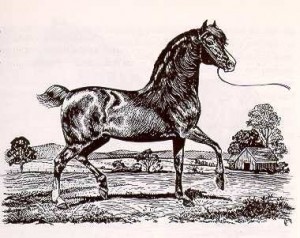
Woodbury Morgan 7
Woodbury Morgan, said to be the “most talked about” son of Justin Morgan, was a dark chestnut foaled in late May, 1816. He was bred by Lyman Wight of Tunbridge, Vermont. His dam was a fifteen hand dark bay mare of unknown breeding. She was a “very free, spirited driver,” considered very fast in her day, that made a “fine appearance” when trotting.
In the fall of 1816, Woodbury was traded for a sleigh (valued at $50.; today: $800) to David Woodbury of Bethel, Vermont. David brother John Woodbury “had a taste for good horses.” John later acquired Woodbury from David and the horse began to develop a reputation under his ownership. Although a good driving horse, it was claimed that Woodbury “made the best appearance under the saddle of any horse in the country.”
Woodbury made appearances at militia training days and musters, plus other related events. The ranking officers of the militia, the colonels and generals, created a constant demand for his use as a parade horse during musters and reviews. Thus, he was always to be seen and, in his case, “to be seen was to be admired.” In this milieu, he furthered the reputation of his sire. His son Gifford Morgan 30 would continue the tradition and himself pass it on to his son Green Mountain Morgan 42.
Woodbury was popular as a military parade horse due to the “the bold, fearless and showy style” he inherited from his sire. At military venues, he had no fear of martial music or the noise created by musket or cannon. Indeed the pomp and ceremony, with flags waving and martial music playing, compelled him to “move about as if he was himself the principal object of attraction and the cause of all the attending excitement and display.”
The tallest of Figure’s three best known sons, Woodbury matured at 14.3 hands. His weight was generally a little over a thousand pounds. As it was the fashion of the day, his tail was docked. The remaining hair was very curly, the hairs being fine, short and soft. Woodbury was a very compactly made horse, with a good chest and shoulders and broad loins. He had a classic head, very wide between prominent eyes. This was topped by the typical Morgan “fox ears;” small and fine, set wide apart.
Woodbury was acquired from John Woodbury by Ebenezer Parkhurst, who kept him until March 1826. At that time, he sold the horse to the partnership of Smith & Walker of Hartland, Vermont, for $500 (today: $12,500+). Soon after the partnership was dissolved. William Walker had a “passion for horses.” Unfortunately for Walker, he was ahead of his time and was unable to make his Morgan horse business pay. He was forced to sell Woodbury for what he felt was the “insignificant sum of four hundred dollars” in May 1830 (today: $10,000+).
Peter Burbank, of Newbury, Vermont, purchased Woodbury, after he had fallen in love with the horse “at first sight.” Burbank was known to have a “discriminating eye for [a horse’s] good points.” Woodbury was boarded at the Johnson Brothers stable in Bradford during the winter months. Burbank stood him at stud in Bradford and Burlington, Vermont, and at Keene, New Hampshire. Burbank died in January 1836 after several months of illness.
Woodbury was sold by the Burbank estate to Norman Bugbee, who took him to Alabama. The traditional story has been that Woodbury broke a leg while being unloaded from the small ship in which he was transported. However, he lived for another two years, dying in 1838. It has been presumed that he may instead have sustained a debilitating injury. An historical marker has been placed near where it is believed he was stabled in Gainesville, Alabama.
