Happy Friday!! Here is your First Friday Flashback, carefully researched and compiled by historian Betsy Curler:
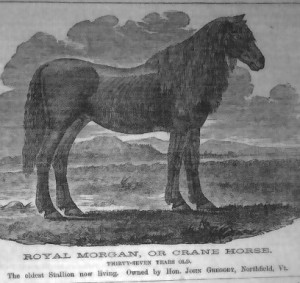
“Royal Morgan 11”
One of the most influential stallions in northern Vermont and the Eastern Townships of Lower Canada during the nineteenth century was Royal Morgan 11. Unlike Gifford Morgan and Hale’s Green Mountain Morgan he was not widely promoted outside the area in which he was owned and used. He was considered to be the epitome of a working horse. Although there are no reports that he was ever used as a parade horse, he was considered “an elegant specimen of his race.” [Wallace, J.H., ed. Wallace’s American Trotting Register. Vol. III, 561.]
Royal Morgan was bred by Mr. __________ Aldrich of St. Johnsbury, VT in 1820. His dam, known as the Aldrich mare (x Justin Morgan), was bred to the Batchelder Horse in the spring of that year.. However, in July she proved to be open and was sent to Sherman Morgan 5 to be bred, rather than being returned to the Batchelder Horse. In 1821, she produced a mahogany bay colt. The colt would become known primarily as Royal Morgan, but would also be known as the Crane Horse, the Steele Horse, the Flint Horse, Morgan Rattler, and the Chamberlain Colt.
Aldrich sold Royal Morgan as a young colt to a party in Maine, where he was known as Morgan Rattler. He remained there until 1829 when he was taken to Derby, Vermont. He was reported to have been sold to Chamberlain & Chase of Lyndon for $400. His next owner of record was Reuben Crane, a tavern owner in Derby Center, Vermont.
Crane owned Royal Morgan for several years and was reportedly quite attached to him. Royal Morgan, although just 13.3 hands high, was renowned for his musculature. Indeed, Solomon Steele noted that he possessed more muscle than any other horse of similar size he had ever known, with the exception of Justin Morgan. Royal Morgan was a horse “of great beauty with extraordinary power of endurance and strength as a horse of all work.” Thus, when a horse was needed for an extraordinary bit of work, one requiring exceptional strength, speed and endurance, royal Morgan became the “go-to” horse.
Solomon Steele purchased Royal Morgan from the estate of Reuben Crane in 1843 and the horse would remain in his care for ten years. Solomon Steele was credited with having had a significant impact on the improvement of horses in his region. In 1847, he along with several others, formed a stock company that purchased Royal Morgan for $500. Known as the Northern Morgan Horse Association,
Their stated purpose was “to perpetuate that noble race of horses and preserve it as nearly as possible in its original purity.” It was noted that Royal Morgan “possessed a greater combination of the Morgan traits of character, than any living horse.” He was “nearly a fac simile” of Justin Morgan.
Royal Morgan passed into the hands of William Baxter of Barton in 1853. The horse was, at this point in time, 32 years old. Baxter had the horse until 1856, when he passed to Mr. ______ Bean of Glover. John Gregory of Northfield, Vermont acquired the horse during the winter of 1857-1858. Gregory exhibited Royal Morgan at the 1858 Vermont State Fair where he attracted much attention as being the oldest known horse then alive (37 years old).
The accompanying woodcut was created from a daguerreotype taken in the summer of 1858. At his advanced age, he displayed the same elastic way of moving he had as a younger horse. He also had blemish-free legs and could still do a square-going trot.
Royal Morgan died about a month after the Fair after becoming cast in his stall. Just the day before he had jumped a three-foot stonewall to get in with other horses – “vigorous” to the end. His death was announced in newspapers as far away as New York City. Royal Morgan’s offspring were noted roadsters and his daughters were prized broodmares.
