Happy Friday! Here is your Friday Flashback – it is a long one, yet an important article written in 1982 from an important person in Lippitt Morgan history:
INBREEDING, LINEBREEDING AND LIPPITTS
by Marshall Winkler
Lippitt Club Newsletter Vol IX, No 5, pp 10-11, Sept 1982
“No matter what our goal is in a breeding program, it is imperative that we start with individual specimens as near our ideal as it is possible for us to obtain. The big problem in breeding is to hold these ideal characteristics and improve upon them.”
This quote is from a book about Guide Dogs for the blind, called “The New Knowledge of Dog Behavior” by Clarence P. Jaffensberger. The information in this book covering breeding principles, training, and general animal husbandry, illumine to a striking degree the breeding history of our Lippitt Horse. The intense inbreeding and line breeding carried out with these California dogs, who were trained with great success to become guide dogs for blind people, is convincing proof that the inbreeding as practiced with our Lippitts is not harmful, and to the contrary, is the key to the survival of the Original Morgan. For years, Robert Lippitt Knight ran an ad on the back cover of the Morgan Magazine, “Lippitt Morgans enjoy a very high percentage of Justin Morgan blood and are bred and offered for sale as pleasure horses.” High percentage of Justin Morgan’s blood means inbreeding. It also implies old fashioned horse values. Knight clearly understood this and he assumed that every breeder who had ever even scanned an extended pedigree, also knew it. His prior background was with cattle breeding; he was a past president of the Ayshire Cattle Breeders Association. It was well understood that linebreeding to outstanding bulls, who were measured by the production of their daughters, was the best way to success with cattle. There is no simple test with Lippitt Horses to compare with the milk pail in cattle as a measure of value.
Knight chose to breed by pedigree. This is simple, preserves the breed, but some of the results were awful. We have all seen ugly Lippitts. The surprise is the occasional beauty that came off the farm – Lippitt Dusky Kate, Lippitt Duplicate, and of course, Lippitt Miss Nekomia, my choice as best Lippitt. Miss Nekomia was a winner in-hand, in endurance rides, and most important, mothered some of our best breeding animals. Considering the size of the herd, the percentage of very good horses was high, higher than the average of most of the other Morgan breeding farms of the day. Most critics only see the culls, ignoring the limited size of the herd. The results were impressive enough to attract a loyal group of younger breeders who are now our Lippitt Club.
Knight is quoted in an earlier Morgan Magazine, “I never nick closer than two generations. I breed the offspring of one stallion to the others”…”I may be elementary in my reasoning”…”I am hewing to the Morgan line.” Hewing to the Morgan line indeed, and certainly elementary in his breeding principles. The stallions were related to each other and to the mares as close as are brother and sister. I liked what I saw at the farm and paid a huge price for Lippitt Minty at the 1962 dispersal. My wife blanched when she realized what I had done. Minty is now 21, has had eleven foals, and late in her life has done well in the sport of combined driving, as has her daughter, Daisy Mint. Family horses, gentle, intelligent and hardy, how could nay horse be better for a backyard owner?
Inbreeding without ruthless selection and culling like this is both a virtue and a problem. The virtue is in the old qualities that survive, all the types that appear in this family – good and bad – are available for our choice and selections. If Mr. Knight had culled rigidly and had narrowed the choice to only one type and then inbred from that one type, our range of choices for today would be limited. Inbreeding with rigid selection fixes a type but the others are lost, perhaps forever. Knight is gone and it now is up to us. The herd of Lippitts is larger, but education is now the pressing problem. It is my belief that hybrid vigor is possible within the Lippitt family because most of the old type survive, are inbred, and if we see regressions we can outcross between types to restore vigor. This principle is explained in “The New Knowledge of Dog Behavior” mentioned earlier. Since few breeders continue for more than 7 or 8 years, the problem of education is large.
Justin Morgan, Hale’s Green Mountain Morgan, and the Aldrich Mare can be reproduced, the genes are there. Because the old breeders inbred, these horses are within our reach.
Lippitt Miss Nekomia is a granddaughter of Bridget 02852. I consider Bridget one of the key horses in the pre-Lippitt family. A. Fullerton Phillips wrote reams about his horses and Bridget was one of his favorites. A look at her extended pedigree will be example enough of the way the old breeders made a breed out of the Morgan. Bred to Ashbrook, she produced Nekomia and Nekomia produced Lippitt Gladys Moro and Lippitt Miss Nekomia, both by Lippitt Moro, a close relative. Lippitt Gladys Moro was a great producer like her full sister. Bred to Moro, Bridget produced John A. Darling. Since all of these horses were very closely related, and since when bred to their close relatives they produced more outstanding horses, no one can say that the Lippitt of today is about to die off, or that the pattern of repeated inbreeding, continued for over 100 years, is destructive. A. Fullerton Phillips believed the early Morgan was valuable. He gathered a herd of these royally-bred animals and so became one of the links in the chain… Robert Knight, J.H. Peters, and Fullerton Phillips.
Linebreeding is a form of inbreeding where an outstanding horse is repeated several times in a pedigree. Inbreeding can be harmful only in the early stages when the recessive traits are combined and appear in offspring. An example of a recessive trait is “Bleeders.” Many race horses bleed through the nostrils when raced hard. This is caused by thin-walled blood vessels and it is wide-spread in Thoroughbreds. It is recessive and inbreeding does not cause it, but inbreeding will cause it to appear, if it is carried by both parents. A long term program of inbreeding has exposed most of the recessives in Lippitts. It is just common sense to breed from the best.
Frank of Ledge Acres was the foundation German Shepard at Guide Dogs for the Blind, Inc., in California. They were building three inbred strains based on: No. 1 – More than 1/2 Frankie; No. 2 – Half Frankie; and No. 3 – Orlos of Longworth along with Frankie. “Outcrosses between the strains will be planned to keep up Vitality.” Our Lippitt inbreeding is based upon Justin Morgan and Hale’s Green Mountain, and we have inbreds with high percentage (15% plus) in the Lippitt strain. The possibilities for outcrossing inside the Lippitt strain are good. In fact, a study of Bridget’s pedigree shows just this kind of outcross within the strain. Bob Morgan, her sire, was inbred to Woodbury and the dam, “chestnut mare,” was inbred through the Streeter Horse to Sherman, Woodbury’s brother. Although this principle wasn’t known to these breeders, Hybrid Vigor is clearly in action here. Read a quote from A. Fullerton Phillips on Bridget: “I have driven Bridget doubled with many different horses, but never found one that could take the evener away from her, no matter how far they were driven, and I have driven her 90 miles in a day. United with this wonderful constitution, she is an animal of superb symmetry of form and remarkable intelligence, which proves that she has not degenerated through inbreeding when there are no constitutional defects on either side.”
Inbreeding is simply mating relatives. Geneticists use a scale from 0 to 1 (or 100%) to measure an inbreeding coefficient. Similar to high percentage, it is just a way to measure the amount of inbreeding that has been used to produce an individual. In dogs, a coefficient of inbreeding of 0.48 was achieved with one litter and these pups went on to become guide dogs with good test scores. In fact, the closer the relationship to the foundation dog, the better the pups scored on training and tests. Keep in mind that 0.50 or 50% is the top coefficient attainable because all genes are paired and each parent contributes only half to an offspring.
Nine years ago, I wrote this ending to “Linebreeding and Lippitts” in the Morgan Magazine: “Pedigrees and remembrances of things past – these go beyond just the genetic make-up of a Morgan. There is a philosophic attraction that can be expressed vaguely as symbolic immortality or the need for a sense of continuity with what has gone before and what will go on after one’s limited biological existence. This is a powerful human drive. It provides some of the cement that holds our society together and certainly is the very essence of Morgans. J.H. Peters is dead, A. Fullerton Phillips is dead, and Robert Lippitt Knight is dead. These three men kept the inbred line intact; now, it is up to someone else.
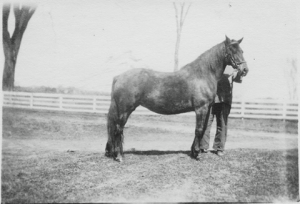
(Photo of Bridget 02852, from Dave Ladd’s Old Box o’ Morgans collection.)
