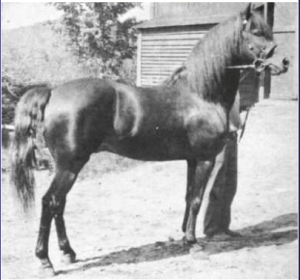
Happy Friday! Here is your Friday Flashback, another piece discussing the breeding of Lippitt Morgans – the photo is of John A. Darling:
“Is the Genetic Pool in Danger” – by Olaf Olofsson of Sweden
(from the LCN Vol XIX, No. 1, 1992, p.8)
In the Stallion Directory, Vol. I (1990), 55 stallions are listed. I have chosen to let them represent 10 straight lines, as illustrated.
Speaking of straight sire lines is, of course, only a technical description of how the blood comes down to new generations, since the daughters carry as much of their sire’s blood as do the sons, and a stallion of a certain line can, in fact, carry the major part of his blood from another line. But, and this is very important, keeping a record of male and female lines is a great tool and helps you to take care of and preserve the different bloodlines within a breed.
From the table, it is obvious that breeding has had a tendency to concentrate on a few sire lines or branches. Through the years, a couple of important sire lines have disappeared. One of the first was the one through Hale’s Green Mountain Morgan. His son Green Mountain 493 was the last stallion of this line. And the Ethan Allen 2nd line through Bob Morgan stopped with Bilirubin. Later on, the turn came to John A. Darling. The branch from his sire Moro, through Lippitt Moro Ash, no longer exists either.
These stallions left their great tribute to the breed through their many good daughters. However, continuing to breed the great producing mares to the same sire lines will cause the loss of a couple of the lines in the table. Originally within the Lippitt Morgan there is only one true sire line, the one from Justin Morgan through Ethan Allen 2nd. But as generations pass, you sooner or later need to divide the stock into different lines of the family, and to update them into new branches.
To illustrate what I’m trying to say, let’s look at the foundation stock. If we let the eight stallions of the foundation stock found different sire lines, we find that originally there were six different lines – Sealect and Sir Ethan Allen representing the same line, as do Bilirubin and Donald. Today three of these sire lines are left. The fact, no matter reason, that only the lines from Croydon Prince, Welcome and Sir Ethan Allen survived caused a great loss to the genetic pool. The true Morgans of that time were in such a small number that every single individual was important stock.
Let’s also hypothetically pretend that the foundation stock were of the same generation, and that the different breeders were in touch and were aiming at the same goal, namely, to produce Morgan stock for future pleasure. Then, with the inability of three of the stallions to reproduce themselves through sons, the daughters of any of the stallions must be bred to a stallion from one of only three possible lines. As generations pass, the influence of the blood descending from the three “incapable” stallions will decrease dramatically, because no mare in the stock can be bred to this blood without getting even more of the blood descending from one or more of the three sire lines.
This principle is adequate also to the Lippitt stock of today. Theoretically, the genetic pool has not been taken care of in the best way.
As a non-controversial example, let’s look at the influence of a horse like John A. Darling. There is a risk that he will turn out to be a beautiful horse that no one is but very little related to. On the other hand, the influence of a horse like Lippitt Ethan Ash is very vital thanks to all his male descendants. According to the Lippitt Register, John A. Darling totally produced 10 offspring from 1942 to 1951, which is quite a large part of the 108 foals totally produced those years. Seven of them left Lippitt offspring. If he had had a male successor, it would have been possible to line-breed to his blood in order to establish a separate branch descending from this horse. Lippitt Ethan Ash produced 20 offspring from 1935 to 1956, 15 of them were used for Lippitt breeding.
What is the actual situation today? Ten of the most notable stallions, representing each of the ten lines, are related to the two stallions as follows expressed in percentage and number of crosses:
Of the 10, John A. Darling has 5 related stallions, 7.8%, and 0.8 average crosses; while Lippitt Ethan Ash has 9 related stallions, 21.9%, with 2.6 average crosses.
Five of the stallions do not trace in any single line to John A. Darling, and only one does not trace to Lippitt Ethan Ash. After no breedings at all to the offspring of a certain horse, this is the second best way to get rid of the influence of this horse, which hardly could have been the wish in the John A. Darling case.
Naturally one can expect a greater influence from a horse with more descendants, but no doubt Lippitt Ethan Ash was very much helped by the fact that three of his sons were able to form their own branches of the tree. If some of the five stallions that trace to John A. Darling also belong to a sire line that is rare, which is the case , one can expect continuing decrease of this blood. If the one who does not trace to Lippitt Ethan Ash represents a rare line, which is also the case, one can expect an increasing influence from Lippitt Ethan Ash if this line disappears.
Nothing can be done about the lost sire lines, but there is very much to do about the living stock. We can also draw the conclusion that the disputed maternal backgrounds of Sir Ethan Allen and Sealect have very little impact today, as does Daniel Lambert’s influence on the foundation mares Evelyn, Susie, and Jenny Woodbury.
Within a small population it is important to separate the bloodlines as much as possible, or all individuals will be too related in a short time. When and if a genetically based disease, defect, or any unwanted factor appears, one can get into big trouble handling it.
With the Standardbred trotter, the breeding on basis of time records has caused a lot of trouble. With a slight exaggeration you can say that every horse who isn’t by Speedy Crown is by Super Bowl. In at least one of the two families, osteochondrosis is routinely being bred. Far too many horses are incorrect in the legs, and they move incorrectly, though some of them are fast. This is pure fact. We see the imported cripples at our Swedish Standardbred stallion breeding evaluation (which does not stop the Swedes from using them at stud, I’m afraid). What to do? Well, horse who suffer too much from defects will become hamburgers, the others will run “like hell.”
All circumstances were presumably not known by the people who bred the true Morgans by the turn of the century. Nor could they do very much about the “alternative” Morgan breeding at the Government Farm. But among Lippitt breeders today, facts are known. Through the Club and the Lippitt Register, all needed information is available. A couple of Lippitt sire lines and branches will disappear pretty soon unless the few remaining representatives of these lines reproduce themselves. For a fair chance to do this, they need the best of mares.
I am not trying to give recommendations on how to run Lippitt breeding programs, since I know that the Lippitt breeder in general is far too knowledgeable to be taught by a newcomer from the other side of the ocean. But perhaps what I have said could be worth consideration if and when there is a choice between stallions of equal quality but of different blood.
Naturally, as important as it is not to concentrate on the same sire lines, it is also important to breed to the best sires. Sometimes it will even work in your favor to drop a sire line.
An investigation of the actual breedings – how people in the 80s have managed to keep up the genetic influence from different bloodlines – might show that I’m totally wrong about any threat to the genetic pool. If so, I’m glad. To this cause, I think it’s urgent to update the Lippitt Registry by publishing a third volume.
Finally, the bone of our mare Madrona Trilby measures 8.0 inches. She does not trace to John A. Darling, but she is still our darling.
