Happy Friday! Here is your Friday Flashback – a remarkable, history-filled, touching piece written in 1985 by none other than Marshall Winkler. Please note that Lippitt Minty is the great-granddam of some the recent Lippitt of the Year horses we’ve featured this week, including several others (i.e., Amadeus Mozart Ara-Li*, Mint Black Jack, Mint Jacob and Marvelous Mint Delite):
Lippitt Minty 1961-1985
by Marshall Winkler
I had Lippitt Minty put down yesterday, the Ides of March. Minty lived a full life. Suddenly, at the turn of the year, her twenty fourth, she started downhill. These last two months were misery for her, and for me watching, as she struggled to get her breath. The hard life caught up to her, other complications set in, and I decided it was extreme cruelty to prolong it. How do you say goodbye to a member of the family?
This summing up is my inadequate goodbye. Minty wrote the lead story in the Lippitt cause, although I, as her human agent, translated it into human terms. Dumb luck or a kind fate brought us together at the 1962 Lippitt dispersal. The kids on the Green Mountain Stock Farm took me by the hand and dragged me down to the end of the far barn, to see Minty. “But Minty,” they said, “she’s our pet.” I bought her and she was our pet for twenty three years. Every day, rain, shine or blizzard, the Winkler family and Minty were together and now the children are grown and gone.
She delivered twelve foals, ten that lived to maturity, and only two that were fillies, Daisy Mint and Amy Mint, a chestnut and a bay. These fillies are easily the pick of the lot and we own them, plus a granddaughter and a great granddaughter. I may be biased but I think they are among the best of the breed that Minty saved from extinction.
D.C. Linsley made a breed out of the Morgan by writing a book about their qualities. Minty saved the threatened and scattered survivors by the sheer strength of her spirit, her inspiration. It was a lonely time when she and I wrote “A New Look At An Old Family.” I was told again and again by the authority figures in the Morgan world, “Breed Lippitts to anything but a Lippitt” and “too inbred.” If she was too inbred, how come she was so strong and vigorous? One hundred and fifty years of inbreeding should have presented me with a sniveling idiot, a three legged monster with two tails and crossed eyes. Other breeders of so-called old type horses had formed the Gold Band Registry, basing their concept upon pedigrees, ignoring the message in those pedigrees. The high percentage concealed the inbreeding and ignores the performance. Implicit in Lindsley was the fact that Morgans were superb doing horses in a world that ran on horse power. Pedigrees were only part of the story.
I was a plant breeder, and Bakewell, the father of modern animal husbandry, was in my library. Minty was inbred, her pedigree shouted this, but she was a powerful, vibrant, intensely alive mare, brimming over with life and energy. “Nuts to them,” I said, and wrote two more articles for the Morgan Magazine on breeding and Lippitts, calling for a club devoted just to Lippitts. One professional, who apparently knew someone who could read, said with a sneer, “Lippitts are like Model T Fords – they belong in a museum.” A pox on all his kind.
She was a big, bold horse, 1300 pounds, and 14.3 hands, short cannons, big hard feet, she climbed a mountain and she could trot the mile, pulling a Meadowbrook in well under three minutes. She was agile in the Gamblers Choice, and she could even jump a 3 foot fence. In short, the perfect backyard family horse. As a two year old, she took my son to the top of Mt. Washington, up the carriage road. At four, she dragged our camp gear into the White Mountain Wilderness of Kancamaguas with her first foal, Rufus, and our small children tagging along. A bear roused her that first night and she snorted wildly, rousting me from my sleeping bag, shouting to save her foal. My children and I fought over who would ride her weekends. Meanwhile, she was raising foals.
Minty, in the middle of her life, started in the new world of Combined Driving along with her 2 year old daughter Daisy. The Lippitt Club got underway at about the same time after the failure of the previous Lippitt Club to get off the ground. This club, started by Robert Morgan and myself at the Green Mountain Stock Farm, reprinted and distributed Minty’s story, “A New Look At An Old Family,” and so drew a couple of hundred letters of interest but no formal club. The Gold Band Registry had also died, but the interest in the old horse was still there, as we learned at Tunbridge before the formal organization of the Lippitt Club of today. Both Minty and Daisy exhibited at all of the first nine shows and the two exhibits and both won the Lippitt of the Year Award in separate years.
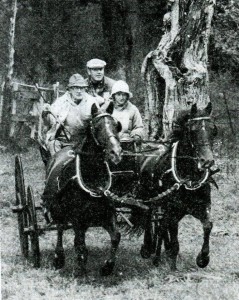
Both Minty and Daisy won twice at the Myopia Driving Event in singles competition driving. When Minty was 21 years old, she and Daisy won their first pair event at Myopia. Minty was old, inbred and a broodmare but nothing dampened her fire. The pair blazed through that marathon in perfect rhythm. I always entered them as Lippitt Morgans and when they won, the world heard about Lippitts.
Minty was the anchor in the wheel in the four-in-hand that I entered at Equifest. This was the climax of my life with horses and the last hurrah for Minty. We won a trophy for the best time in the hazards. We went on to compete at the New England Morgan Show, Carriage Division, and from there to Sturbridge Village, where the team pulled a Mountain Stage Coach through the covered bridge for a National Park Service film on Henry David Thoreau.
When she was four, twenty years ago, she was the best horse I have ever known. For almost twenty three years, our family shared a sweet-tempered mare with a big heart. At 21, she lit the heavens with her glow after winning the pair division at Myopia. She trained my four-in-hand, steady, steady, steady, with two of her children in the lead.
When she joined us in 1962, the Lippitt was on the verge of death as a true breed in a hostile world of show Morgans, Morgans in name only. It would have been easy to outcross her as all but a tiny few were doing. The outcrosses sold better. She rapidly convinced me this would be a crime. I told the world what I had learned about this great family through Minty and the response finally surprised even me.
There will never be another Minty and we will miss her, all of us, deeply.
Yours for Lippitts, Marshall N. Winkler
(Photo of Marshall, Minty and Daisy entering the Water Hazard.)
Article and photo from LCN Vol XII, No 3, May/June 1985, pp 8-9.
