Bulrush Morgan 6
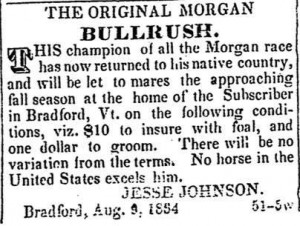
[Note – new information on Bulrush Morgan was found by the author two weeks ago and is included here. Thanks to Bruce Orser for locating the featured 1834 advertisement for Bulrush; also ‘new’ to us. – Betsy Curler]
Bulrush Morgan 6 was known by several names, including but not limited to, the Belknap Horse, the Delano Horse, the Chelsea Horse, and Morgan Bullrush. It is not known when he became associated with the name Bulrush, but an 1829 ad for a son of his used the name Morgan Bullrush. It was then common for a horse to be known by the name of his sire or the family of horses with which he was associated. Wier claimed that he became known by that name 10-15 years to his acquisition of the horse.
Bulrush was one of the three best known sons of Justin Morgan. He sired numerous progeny in the central Vermont area, ranging east from Randolph to Bradford and north to Williamstown. He was also at stud in the southern and western areas of Caledonia County and the Hartland, Vermont area. In addition, he spent a few years in Maine and portions of New Hampshire.
Although the breeding of Bulrush’s dam was unknown, it was said to be part French Canadian and she resembled that breed in appearance. Moses Belknap of Randolph, Vermont, obtained this mare via a trade with a teamster named Boutwell, who freighted merchandise and produce between Montpelier, Vermont and Boston. This mare was “very hardy, rugged and enduring.” Although just 14.0 hands, she weighed a hefty one thousand pounds. She was compact and had “heavy” limbs with large joints, plus had a long neck, which she did not carry up well. She was a “sharp trotter,” but was not considered to be a spirited driver.
Belknap sold the mare late in the winter of 1811-1812 to Ziba Gifford of nearby Tunbridge, Vermont. She was in foal to Justin Morgan at the time of the sale. If Gifford decided to keep the resulting foal, he would pay Belknap an additional $13, but if he did not want the foal, he would give it [back] to Belknap. Gifford returned the foal to Belknap, who raised him, and kept him until 1819. At that time, he was sold to Abel Densmore of Chelsea, Vermont. While owned by Densmore, he stood at stud in Williamstown, Vermont and was used as a parade horse there.
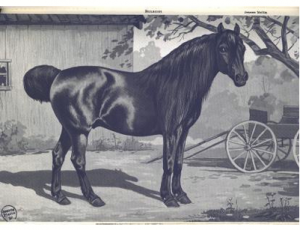
Bulrush was noted as a trotter, and it was claimed that he “would pass for one” in 1885. He was credited as the source of speed of the Morrill family and, overall, the speed of his stock as trotters outdid those of the Woodbury and Sherman families. Physically, he resembled his sire and half brothers strongly. He was “stout built” with pronounced muscling and a broad back. His hips were considered to be very good, but his shoulders were thick and his neck not as well set on as those of his half brothers. It was noted that it was not a ewe neck.
Bulrush was noted for his extraordinary “lastingness” (endurance) and “strength forward.” This trait was considered to be his most important attribute and one that he was noted for his entire life. His tail was docked when young, but it was very full, and his mane went almost to his knees and his foretop to his nose. He was known to be cross, “but not fierce,” and worked kindly and pleasantly in harness. As with his brothers, he was worked steadily until he was about ten years of age.
Densmore sold Bulrush to Darius Sprague of Randolph, Vermont, but no date has been provided for this transfer of ownership. From Sprague, he passed to the partnership of Simon Smith and William Walker of Hartland, Vermont in March 1826. The partnership also owned Woodbury Morgan. When the partnership was dissolved in 1829, Bulrush Morgan became solely owned by Smith and/or his sons, Simon Jr. and Spaulding Smith. Spaulding and Simon Jr. were in business together and had moved north to Maidstone, Vermont. There they established a farm together, which became very successful within a few years.
After Spaulding married the daughter of a prominent Maidstone farmer, he moved to Wilton, Maine, where he became a successful and widely known stock breeder. Bulrush was kept at stud by the Smiths for one year in Chelsea, Vermont, then went to Spaulding Smith’s farm in Maine for a few years. If Wier’s estimation of when the horse became known as Bulrush, it might have been acquired while he was in Maine. By this time, the old horse had attained the age of twenty years.
Bulrush remained active as a breeding horse for several more years. From the Smiths, he returned to Vermont under the ownership of Jesse and R.C. Johnson in Bradford, Vermont. Under their ownership, Bulrush’s breeding circuit included Bradford and Burlington, Vermont, plus Keene, Bath and Lyme, New Hampshire.
In the winter of 1836-1837, the Johnsons sold Bulrush to Blake & Foss of Chelsea, Vermont. In 1842, he passed into the hands of Lewis Jenkins of Fairlee, Vermont. Circa 1844, F.A. Wier, who was collecting the remnants of the offspring of Justin Morgan, became the owner of Bulrush Morgan. Bulrush died at the age of 36 years while owned by Wier.
Of the three most prominent sons of Justin Morgan, the stock of Bulrush were least numerous in the breeding ranks and of those exhibited at the agricultural fairs. As a sire, he appears to have been just as popular and respected in his day, as he was said to have sired numerous offspring. The majority of these offspring most likely were sold as working horses. The endurance and hardiness of that family were well known and would have created a strong demand in that sector of the market for them.
