Happy First Friday!!! Here is your First Friday Flashback, provided by historian Betsy Curler:
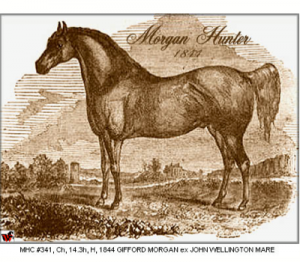
Morgan Hunter 341
In the June 1849 issue of the Cultivator, the editor noted that F.A. Wier had recently passed through Albany on his way to East Hamilton, NY, with the stallion Morgan Hunter. He noted that Morgan Hunter was a “fine horse” and suggested that “Persons who want to know what a Morgan horse is, will do well to examine him.” Morgan Hunter 341 was a son of Gifford Morgan out of a daughter of Gifford Morgan. A.F. Phillips felt that “Morgan Hunter was [an] extraordinary example of inbreeding,” which “resulted in one of, if not the highest finished horses of The Woodbury family.”
The surname of the breeder of Morgan Hunter is in some doubt (Ewell, Exwell, or Axtell), but he was foaled in Springfield, Vermont in 1844. He was sold to F.A. Wier, who in turn, sold him to H.R. Ackley and S.A. Gilbert in May 1849. Soon after his sale to the East Hamilton, NY partners, his woodcut and a detailed description was published in the Cultivator. From there, it was reprinted in other farm journals.
The woodcut was said to give a “fair representation” (although one stated unequivocally that it was not) of the horse, but all agreed that it was not as good as the horse himself. the Cultivator went on to say: “He is a capital specimen of the Morgan family of horses. In his general form, he possesses in a remarkable degree, what Youatt lays down as the most important requisition in a stallion—compactness—“
The Massachusetts Ploughman went on to say: “We totally object to breeding from the rawboned, long legged, high-heeled animals that need a stake beside then in a high wind. Let us have no projecting bones, or useless prominences, or crooked limbs, when we can have straight ones as well. As to size we are most decidedly opposed to large carcasses and large bones for common service. If war horses are to be reared whose mere weight is expected to bear down all opposition the case is different. But we want no war horses. We want them for draft and for easy carriage.”
It is uncertain how long Morgan Hunter remained in New York. He was exhibited at the New York State Fair in 1849 and 1851. In 1851, he won the second premium for stallions. He was advertised to stand at stud in 1851 at S.A. Gilbert’s stable in East Hamilton for “$10 to insure.” The ad boasted that Morgan Hunter possessed “more Gifford blood than any other living horse.”
By the 1854 breeding season, he was owned in Virginia. He was standing in Charlottesville during the spring and early summer, which was to be followed by a full season in Augusta, GA. The Southern Planter noted that Morgan Hunter was: “Coming up in form and action, spirit and docility to all the characteristics which we have seen attributed to the Morgan horse, we have no doubt the he is of that stain; and the only thing that induces us to suspect him, is that we cannot imagine what could make the yankees send a specimen apparently so perfect, so far from home.” The Southern Planter considered him a noble little animal” and “in his form the model of a road horse.” They stated his height was 14.1 1/4 hands and that he weighed a hefty 1,100 pounds.
In 1856, he was owned by Farris & Cook of Charlottesville, VA. At an exhibition of horses held at the Court House, he was among horses that “the best we have ever seen.” The horses “attracted much attention by their action and symmetrical proportions.” This is the last that we hear of this paragon of Morgan horses. The Vermont Horse Stock Company, when it announced its establishment in 1871, used the Morgan Hunter woodcut to exemplify “one of the best representatives of the Morgan breed in his prime.”
Note – Linsley gives Morgan Hunter’s height as 14.3 hands and noted that he “is a horse of beautiful figure and fine action.” Battell repeated this in the Morgan Horse and Register, vol. I. Phillips admired his “symmetry of form and great vivacity.”
